
- Simplify Your Compliance
CBAM Reporting Solutions
Navigate the Carbon Border Adjustment Mechanism with confidence. From expert CBAM reporting to verified validation, we help Indian manufacturers and global exporters reduce carbon taxes and secure EU market access.
Trusted by forward-thinking importers
- EcoCorp
- GreenLogistics
- TechTrade
- GlobalSteel
Everything you need for CBAM
Our comprehensive suite of CBAM services ensures your business remains compliant while optimizing your carbon strategy.
Expert CBAM Reporting
Accurate, timely, and fully compliant CBAM reporting Services handled by our environmental data specialists. We navigate the complex EU Transitional Registry so you don't have to.
Verified & Validated
Get peace of mind with Cbam reports that are rigorously verified and validated by accredited third-party auditors to ensure absolute compliance.
CBAM Consultant in India
Local expertise for Indian exporters. Our localized CBAM consultants understand your supply chains, Indian grid emission factors, and unique operational challenges.
Reduce Carbon Tax
Proactive strategies to optimize your supply chain, source greener alternatives, and ultimately minimize your financial exposure to carbon taxes.
Flawless CBAM Reporting for Indian Exporters
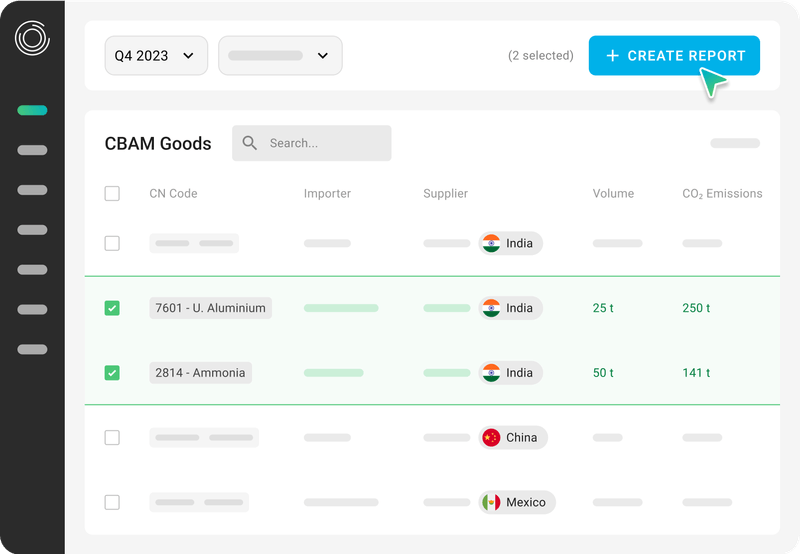
The Carbon Border Adjustment Mechanism doesn’t have to threaten your European exports. By partnering with a top-rated CBAM consultant, Indian manufacturers can automate their end-to-end CBAM reporting and ensure reliable data capture.
- Comprehensive supplier data collection
- Real-time carbon tax forecasting
- Direct integration with EU CBAM Registry
- Dedicated account manager & compliance expert
Frequently Asked Questions
Everything you need to know about CBAM services.
What is CBAM?
Who needs to submit a CBAM report?
How does your service work?
Can you help reduce our carbon tax liability?
Does EU CBAM Affect Your Business?
Failing to comply can trigger hefty CBAM fines of ₹900 to ₹4,500 per tonne of unreported CO₂.
Across India’s industrial belt, factory managers already juggle orders every Monday morning. Now, many must also prepare quarterly CBAM reports. It adds new pressure to already packed schedules. This is not just paperwork. Accurate reporting can decide whether your next big export order goes through.
What are products covered under the CBAM List?
Initially, CBAM EU applies to imports of the most carbon-intensive goods from specific sectors. The transitional phase, which began in October 2023, covers the following sectors:
- Cement
- Iron and Steel
- Aluminium
- Fertilisers
- Electricity
- Hydrogen
It also covers select downstream products, like screws and bolts, widening the compliance net. If your exports include these, compliance is unavoidable (CBAM goods list).
Who Qualifies as a CBAM Declarant in India?
If your Indian company exports goods to the EU worth more than ₹13,500 (€150) a year, you are officially a CBAM declarant.
This means you need to report CBAM carbon data and buy CBAM certificates. It is not just the big multinationals headquartered in India. Even European subsidiaries of Indian companies importing CBAM goods fall under the same rules (PwC India, 2024).
Perhaps you’re already feeling a bit overwhelmed. You’re not alone.
How Technology Simplifies CBAM Compliance?
Tracking emissions across multiple suppliers and facilities is overwhelming if done manually. Spreadsheets often fail.
Technology makes it manageable. Digital carbon accounting platforms, blockchain-based traceability, and AI-powered analytics automate calculations. They verify supplier data and generate audit-ready reports.
Several Indian startups and consulting firms now provide solutions tailored to local exporters. Beyond compliance, these tools offer insights into your CBAM carbon data.
Perhaps you discover that one supplier produces most of your emissions or that small changes in production save both costs and carbon.
Investing early in technology can turn regulatory pressure into a strategic advantage. What once felt like a headache becomes an opportunity.
Why do I need a CBAM consultant in India?
How does CBAM reporting work during the transitional phase?
Ready to simplify your CBAM compliance?
Join hundreds of importers who trust Cbam.in to handle their reporting, validation, and carbon tax reduction strategies.