
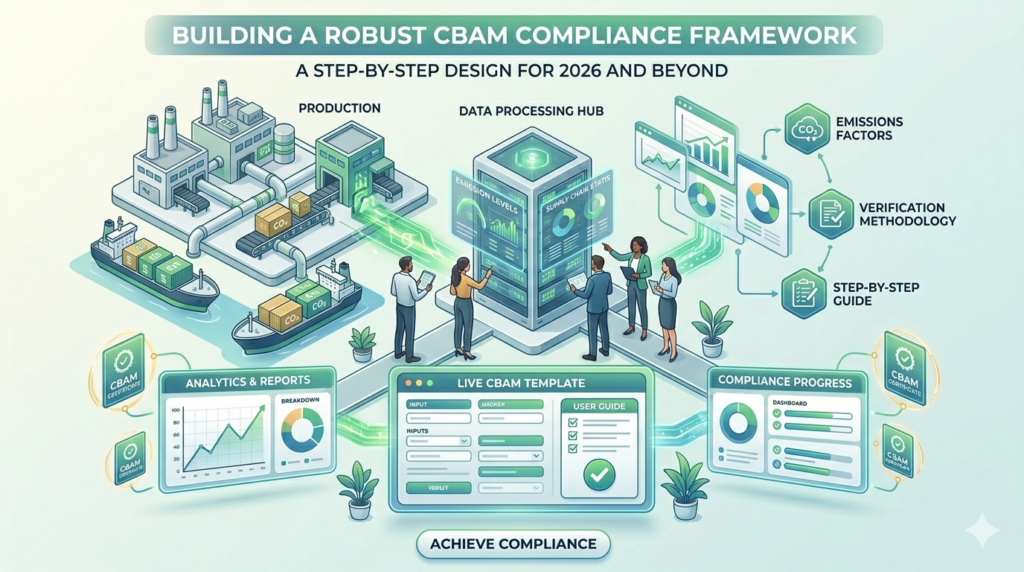
A CBAM template is no longer a nice extra. It has become a practical bridge between messy supplier data and the reporting demands that sit behind CBAM. The European Commission says CBAM moved into its definitive regime from 1 January 2026, after the transitional phase that ran from 2023 to 2025, and it also maintains a CBAM registry and reporting structure for importers and operators.
A strong CBAM compliance template is therefore not just a form. It is a working file, a data discipline, and a small compliance system that keeps people from guessing when the numbers matter. That is the real point. Not decoration. Not paperwork for its own sake. A clean structure that can survive supplier variation, internal review, and eventual verification.
Step 1: Start with the exact goods and reporting scope
The first step is deciding what the template is supposed to cover. That sounds basic, but it is where many teams drift into confusion. CBAM reporting depends on the specific good, the CN code, the production route, and the installation that made it. The Commission guidance says the communication should include installation identification, location details, production processes, and the relevant goods category or CN code.
A useful CBAM template should begin with a clear scope page. That page should answer simple questions before anything else gets filled in.
- Which CBAM goods are covered.
- Which supplier or installation is sending the data.
- Which production route applies.
- Which reporting period does the data covers.
Step 2: Build the supplier data section first
The European Commission’s guidance makes one thing very clear. The operator must compile monitored data for the whole reporting period and determine attributed emissions by production process. The template exists to simplify that exchange, especially where suppliers are spread across different countries and do not all speak the same language.
That means the supplier section should not be vague. It should ask for the data that actually drives the report. In practice, a CBAM compliance template should capture the following fields as a minimum:
- Installation name and address.
- Contact details for the authorised representative.
- Production process or route.
- Direct specific embedded emissions.
- Indirect specific embedded emissions.
- Data source used for the emission factor.
- Whether calculation-based, measurement-based, or another method was used.
- Whether default values were used, and why.
Step 3: Separate required data from optional detail
This is one of the smartest parts of the Commission’s approach. The template has two parts. Part 1 contains the information required to compile the CBAM report. Part 2 is optional but recommended because it adds transparency and helps the importer validate Part 1.
That structure is worth copying carefully. A strong CBAM template should clearly mark what is mandatory and what is a supporting detail. Otherwise, suppliers waste time overfilling nonessential fields while still missing the fields that are actually needed. That kind of confusion is common, and it slows everyone down.
A practical setup looks like this:
- Part 1 for required reporting data.
- Part 2 for supporting evidence and transparency.
- Clear labels for optional fields.
- Notes that explain why each field exists.
Step 4: Add the calculation logic early
A template that only collects text fields will not be enough. CBAM reporting depends on emissions calculations, and the Commission guidance says the spreadsheet version of the template includes automatic calculation of CBAM embedded emissions data from inputs. It also supports attribution of emissions across production processes and includes tools for CHP or cogeneration and carbon price calculations.
That means calculation fields should appear inside the template, not outside it. The logic should show how total emissions become specific emissions. It should also show how the activity level is used to arrive at the reported figure. When that logic is visible, review becomes easier. When it is hidden, problems surface later.
A good CBAM compliance template should therefore include columns or cells for:
- Activity data.
- Emission factors.
- Calculation method.
- Attribution by process.
- Final specific embedded emissions.
Step 5: Add validation, evidence, and quality checks
This step is where a template becomes credible. The Commission’s guidance says Part 2 can be used by reporting declarants to carry out validation checks on Part 1. It also asks for information on data quality, methods used, and whether verification has been applied.
That means the template should not just ask for values. It should also ask how those values were created. Was the figure based fully on monitoring, or were default values used. Was the emission factor taken from a supplier document, a power purchase agreement, or another source. Were there any corrections or estimations. These are the questions that protect the report later.
A practical quality section should include:
- Source of each key emission factor.
- Notes on data gaps.
- Default value justification, if used.
- Verification status.
- Supporting files or references.
This is also where software can help. Cbam Platforms such as Sphera, Coolset, Persefoni, Sweep, Normative, Plan A, and Watershed all position themselves around emissions data, reporting, audit readiness, or supply chain collaboration, which makes them relevant when building a cleaner CBAM template workflow.
Step 6: Make the template easy for suppliers to use
A template fails quickly if suppliers hate using it. That may sound blunt, but it is true. The Commission guidance repeatedly emphasizes simplicity, shared format, and clarity across different languages and countries. That is exactly why the common template exists in the first place.
So the layout should stay readable. Field names should be short. Instructions should be plain. Mandatory fields should be obvious. Optional fields should not block the process.
A good CBAM compliance template should feel like guided data entry, not a puzzle. If suppliers can understand it in one sitting, the odds of better data go up. That is not a dramatic insight. It is just how human behavior works.
Step 7: Test it against a real reporting cycle
A template should never be launched as a theory. It needs a test run.
The best way to check a CBAM template is to apply it to one product, one supplier, and one reporting period. Then review what breaks. Missing fields, confusing labels, duplicate entries, and weak calculation logic usually show up fast. The Commission’s guidance notes that the template is designed to help operators share the necessary embedded emissions data with importers in a structured way, and that structure should survive real use, not only nice-looking design.
What a solid CBAM template should contain
A clean CBAM template usually works best when it includes these core blocks:
- Company and installation data.
- Product and CN code details.
- Production process information.
- Direct and indirect emissions.
- Data source and methodology notes.
- Optional evidence and validation fields.
- A summary sheet for importer review.
This format mirrors the Commission’s recommended communication structure and makes it easier for importers to compile reports in the CBAM system. It also reduces the temptation to hide gaps behind broad estimates. CBAM is too close to the financial side of trade for that kind of loose handling.
A practical closing thought
CBAM has already entered its definitive phase, and the CBAM registry is being built to support importer reporting from 2026 onwards. That makes template quality a very practical issue, not a side task. A well-designed CBAM template lowers confusion, and a well-maintained CBAM compliance template lowers risk. The difference sounds small, but in compliance work, small differences often become the whole story.
For teams that want a more organized way to handle all this, Cbam.in can be a useful place to start. A clear process tends to save time later, and sometimes that is the real win.
FAQs
1. What is a CBAM template used for
A CBAM template helps suppliers share embedded emissions data in a standard format, so importers can complete CBAM reporting more accurately. The Commission says the common template simplifies communication across countries and languages.
2. Is the CBAM template mandatory
The Commission guidance describes the template as voluntary, but highly useful because it standardizes the information exchange and supports cleaner reporting.
3. What information should a CBAM compliance template include
It should include installation data, production routes, direct and indirect emissions, calculation methods, emission factor sources, default value notes, and optional transparency details such as verification and heat balance information.
4. Which software tools can support CBAM template creation
Tools such as Sphera, Coolset, Persefoni, Sweep, Normative, Plan A, and Watershed can support emissions data collection, audit readiness, reporting templates, and compliance workflows.
5. Why does the template need both required and optional sections
The required section gives importers the data they need for reporting. The optional section adds transparency and helps validate the core figures, which improves trust in the final CBAM report.