Something about global trade feels different lately. The shift is subtle, almost quiet, but it keeps showing up in conversations around compliance, sourcing, and cost. Carbon is no longer a distant sustainability topic. It is sitting right inside trade decisions.
The European Union’s Carbon Border Adjustment Mechanism has pushed this change forward. It asks a simple question on the surface. What is the carbon footprint of the products entering the EU market. But the answer is rarely simple.
Companies are now expected to measure, report, and eventually pay for embedded emissions. That is where complexity begins to unfold. Data comes from multiple suppliers. Calculations depend on processes. Reporting formats must align with strict regulatory structures.
This is exactly where CBAM software tools start to matter. Without structured systems, compliance can quickly turn into confusion.
Understanding the Shift Behind CBAM
At first glance, CBAM may look like a reporting rule. It is not just that. It is a structural change in how imports are evaluated.
Products like steel, cement, aluminum, fertilizers, electricity, and hydrogen are already covered. These sectors carry high emissions. That is not new. What is new is the requirement to prove those emissions with data.
During the early phase, companies mainly submit reports. From 2026 onward, financial exposure becomes real. Certificates must be purchased based on emissions.
So accuracy becomes more than a compliance requirement. It becomes a cost factor.
That is why CBAM compliance software is gaining attention across industries. It helps manage something that is otherwise difficult to track manually.
Why Manual Processes Start Breaking Down
At first, spreadsheets seem enough. Data is collected. Numbers are entered. Reports are created. Then reality starts interfering.
One supplier sends incomplete data. Another uses a different format. Someone forgets a unit conversion. A formula breaks. Versions do not match. It becomes messy quickly.
Now imagine this across hundreds of suppliers and multiple product lines. That is when manual systems begin to fail.
CBAM software tools step in to structure this process. They do not remove complexity, but they make it manageable.
What Good CBAM Software Actually Does
A strong system does not just store data. It connects multiple steps into a single flow.
It collects supplier data in a structured way. It calculates emissions based on accepted methodologies. It prepares reports in the required format. It keeps records ready for audits.
More importantly, it reduces uncertainty.
That is why many companies are moving toward CBAM compliance software earlier than expected. Waiting too long may create unnecessary risk.
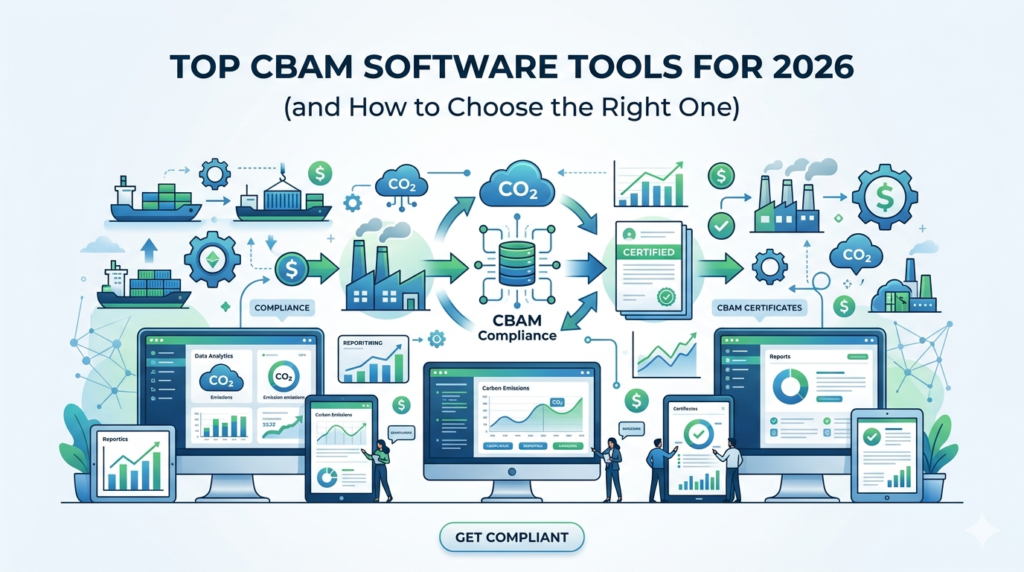
Top CBAM Software Tools for 2026
Now comes the practical part. Several platforms are emerging to support CBAM requirements. Each has a slightly different approach.
Some focus on carbon accounting. Others focus on enterprise-level sustainability. A few are building specific CBAM modules.
Let’s walk through some of the most relevant tools.
1. Sphera
Sphera is widely used in environmental compliance and risk management. It offers deep capabilities in lifecycle assessment and emissions tracking.
For CBAM, this becomes useful because emissions must be calculated based on actual production processes. Sphera provides detailed modeling tools that can handle such complexity.
It may feel slightly heavy for smaller businesses. But for large supply chains, it offers strong depth.
2. Coolset
Coolset focuses on simplifying carbon accounting. The interface feels more accessible compared to traditional enterprise tools.
It supports emission calculations, reporting workflows, and compliance tracking. The approach is more user-friendly, which helps teams that are new to CBAM.
Some limitations may appear in very complex supply chains. Still, for mid-sized companies, it provides a good balance.
3. Persefoni
Persefoni is designed as a climate management and accounting platform. It aligns closely with financial reporting structures.
This is useful because CBAM is not just environmental reporting. It connects directly to cost and financial exposure.
Persefoni supports structured data handling, audit readiness, and reporting consistency. It may suit companies that want tighter integration between finance and sustainability.
4. Sweep
Sweep focuses strongly on collaboration. It allows companies to collect emissions data across teams and suppliers.
This becomes important in CBAM, where supplier engagement is often a weak point.
The platform helps standardize inputs and track progress. It may not solve every technical calculation challenge, but it improves coordination.
5. Normative
Normative emphasizes science-based carbon accounting. It focuses on accuracy and alignment with global standards.
For CBAM, this approach is useful because calculations must be credible and verifiable.
The system helps companies move beyond rough estimates and toward precise measurement. That shift can improve reporting quality significantly.
6. Plan A
Plan A offers a mix of carbon accounting and ESG reporting features. It is designed to support compliance while also guiding reduction strategies.
This dual approach can be helpful. CBAM is not only about reporting emissions. It also pushes companies to reduce them over time.
The platform provides insights that may support both goals.
7. Watershed
Watershed is known for handling large-scale enterprise emissions data. It provides detailed analytics and reporting tools.
It works well for companies with complex global operations. Data integration is one of its stronger areas.
For CBAM, this means smoother handling of large datasets and multiple reporting layers.
Choosing the Right Tool Without Getting Lost
There is a temptation to look for the best tool overall. That approach rarely works.
Instead, the better question might be simpler. What fits the current business structure?
Some companies have limited suppliers. Others manage global networks. The level of complexity changes everything.
When evaluating CBAM software tools, a few points stand out.
- Data collection should feel manageable for suppliers
- Calculations should follow accepted methodologies
- Reports should match regulatory formats
- Audit trails should be clear and accessible
These are not advanced features. They are basic requirements.
Ignoring them can create problems later.
A Small Reality Check on Automation
Automation sounds attractive. It promises speed and efficiency. But if the underlying data is weak, automation amplifies errors. So the focus should remain on accuracy first.
Many CBAM compliance software platforms highlight automation. That is useful, but only when calculations are reliable.
Accuracy always comes before speed.
Common Challenges Companies Are Facing
Across industries, similar patterns can be seen.
- Suppliers struggle to provide consistent data
- Internal teams lack coordination
- Reporting timelines create pressure
- Data validation becomes time-consuming
These challenges are structural. They are not limited to one sector.
That is why relying only on manual workflows often becomes difficult over time.
Looking Ahead to 2026 and Beyond
CBAM is still evolving. Tools are evolving with it.
Future systems may integrate directly with supplier databases. Data collection may become more automated. Cbam Reporting could become faster.
But one thing is unlikely to change. The need for accurate emissions data will remain constant.
Companies that build strong systems early may find it easier to adapt later. Others might struggle to catch up.
A Thought That Keeps Coming Back
CBAM is often treated as a compliance burden. That is understandable. But it may also be something else. A signal.
A signal that carbon is becoming part of economic value. Something measurable. Something priced.
Software helps manage the process. But the deeper shift is in how businesses think.
Some companies may resist it at first. Others may adapt faster.
If the goal is to simplify this transition and reduce unnecessary confusion, platforms like Cbam.in could offer a more structured path forward.
Clarity, after all, tends to make difficult processes easier to handle.
FAQs
1. What are CBAM software tools used for?
CBAM software tools help companies collect emissions data, calculate carbon values, and prepare compliance reports for EU regulations.
2. How is CBAM compliance software different from general ESG tools?
CBAM compliance software focuses specifically on import-related emissions and regulatory reporting, while ESG tools cover a broader sustainability scope.
3. Do all exporters need CBAM software immediately?
Not always, but companies with complex supply chains may need it earlier to avoid data and reporting challenges.
4. Which industries are most affected by CBAM?
Industries like steel, cement, aluminum, fertilizers, electricity, and hydrogen are currently covered.
5. What happens if emissions data is inaccurate?
Inaccurate data may lead to penalties, higher costs, and compliance risks during verification processes.
6. Can CBAM tools also help reduce emissions?
Some tools provide insights that help companies identify high-emission areas and improve efficiency over time.